Article-At-A-Glance: What Plants Are Actually Saying
- Plants communicate through at least four distinct systems — electrical signals, airborne chemicals, underground fungal networks, and even ultrasonic sound — making them far more sophisticated than most people realize.
- When a plant is attacked, it can warn its neighbors within minutes using volatile organic compounds, giving surrounding plants time to activate their own chemical defenses before the threat arrives.
- The “Wood-Wide Web” is a real underground fungal network connecting trees and plants across entire forests — and what plants exchange through it may surprise you.
- Plant communication research has real agricultural implications, from detecting crop stress without touching a single leaf to potentially revolutionizing how we feed a growing global population.
- If you’ve ever smelled freshly cut grass, you’ve already received a chemical distress signal from a plant — you just didn’t know it.
Plants are having constant conversations — you just haven’t been able to hear them until now.
The green world surrounding us, from a towering 300-foot sequoia to a small basil plant on a kitchen windowsill, is locked in a continuous exchange of information. For decades, botanists and ecologists assumed plants were largely passive organisms, reacting only to sunlight, water, and soil. What researchers have uncovered since is something far more remarkable. Plants send warnings, call for help, recognize their relatives, and share resources with their neighbors — all without a brain, a mouth, or a nervous system in the traditional sense.
Understanding how plants communicate isn’t just a fascinating scientific curiosity. The benefits of this communication — both for plant ecosystems and for human applications in agriculture and environmental science — are reshaping entire fields of research. For those passionate about the plant world, Soltech is one resource helping plant enthusiasts explore and understand these deeper dimensions of plant life.
Plants Talk — And It’s More Complex Than You Think
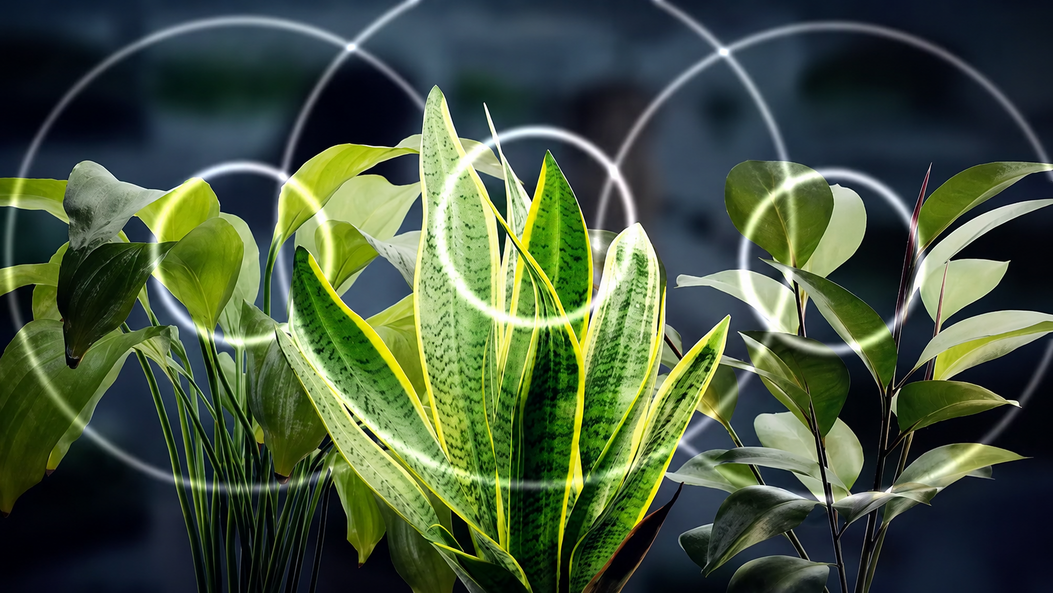
“Plants Talk, We Just Don’t Hear Them” from brightside.me and used with no modifications.
Most of us learned in school that plants respond to light and grow toward it. What the textbooks left out is the staggering complexity of what happens between plants — and within them — at any given moment. A single tree under attack by insects can simultaneously signal its own branches to produce defensive chemicals, release airborne warnings to trees dozens of feet away, and send distress messages through a network of underground fungi to its neighbors. All of this can happen within minutes of the first threat.
The mechanisms plants use to communicate fall into several distinct categories, and each one has its own language, speed, and purpose. Some signals travel internally, coordinating the plant’s own response to stress. Others travel through the air or underground, reaching entirely different plants and species. And some, as research published in the journal Cell in 2023 revealed, travel as ultrasonic sound waves — a discovery that upended long-held assumptions about what plants are capable of.
How Plants Communicate Within Themselves
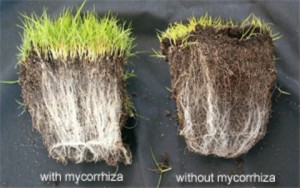
“How plants communicate – Edaphic Scientific” from edaphic.com.au and used with no modifications.
Before a plant can send a message to its neighbor, it has to communicate with itself. A plant’s roots, stems, leaves, flowers, and fruit are not operating independently — they’re constantly sharing information to coordinate a unified survival response.
Electrical Signals: The Plant Nervous System
When a plant is wounded — whether by a chewing caterpillar, a snapping stem, or drought stress — electrical signals radiate out from the injury site almost immediately. These signals travel through the plant’s vascular tubes, called the xylem and phloem, via the movement of ions and charged chemicals. Simon Gilroy, a botanist at the University of Wisconsin-Madison, has demonstrated this process clearly in research using fluorescent markers that light up as electrical pulses travel through a plant in real time.
What makes this particularly striking is that these signals don’t just stay inside one plant. If two plants are physically touching, electrical distress signals can pass between them. Think of it as the plant equivalent of grabbing a friend’s arm to warn them of danger. For more insights on plant interactions, explore our urban greening guide.
- Trigger: Physical damage, drought, temperature extremes, or pathogen attack
- Signal type: Electrochemical impulse traveling through vascular tissue
- Speed: Can travel across a plant within seconds to minutes
- Result: Activates defensive chemical production, closes stomata, redirects resources
- Cross-plant transmission: Possible through direct physical contact between plants
Researchers are now investigating whether these electrical signals also play a role in something even more surprising — plant memory. There is growing evidence that some plants can retain information about past stress events and respond more efficiently when the same threat appears again.
Hormones and Chemicals Moving Through the Plant
Alongside electrical signals, plants use hormones to relay internal messages. Jasmonic acid is one of the most critical. When a leaf is damaged, Jasmonic acid floods through the plant’s vascular system, triggering the production of defensive compounds like tannins and protease inhibitors that make the plant’s tissue less digestible to insects. Abscisic acid plays a different role, acting as the plant’s drought alarm by signaling stomata to close and conserve water when roots detect dry conditions. These hormones move more slowly than electrical signals but carry more detailed chemical instructions. For more insights into plant care, explore this urban greening guide.
How Roots and Leaves Share Critical Survival Information
The relationship between a plant’s roots and leaves is one of the most elegant internal communication systems in nature. Roots detecting drought don’t just sit there suffering — they send abscisic acid upward through the xylem to the leaves, which then partially close their stomata to reduce water loss. This happens before the leaves themselves experience any water stress. Courtney Jahn, a biologist and NSF program director who studies plant interactions, has described this as a predictive system — the plant responds to what’s coming, not just what’s already happening. For those interested in enhancing their gardening practices, exploring companion planting ideas can be beneficial.
The Chemical Language Plants Use to Talk to Each Other
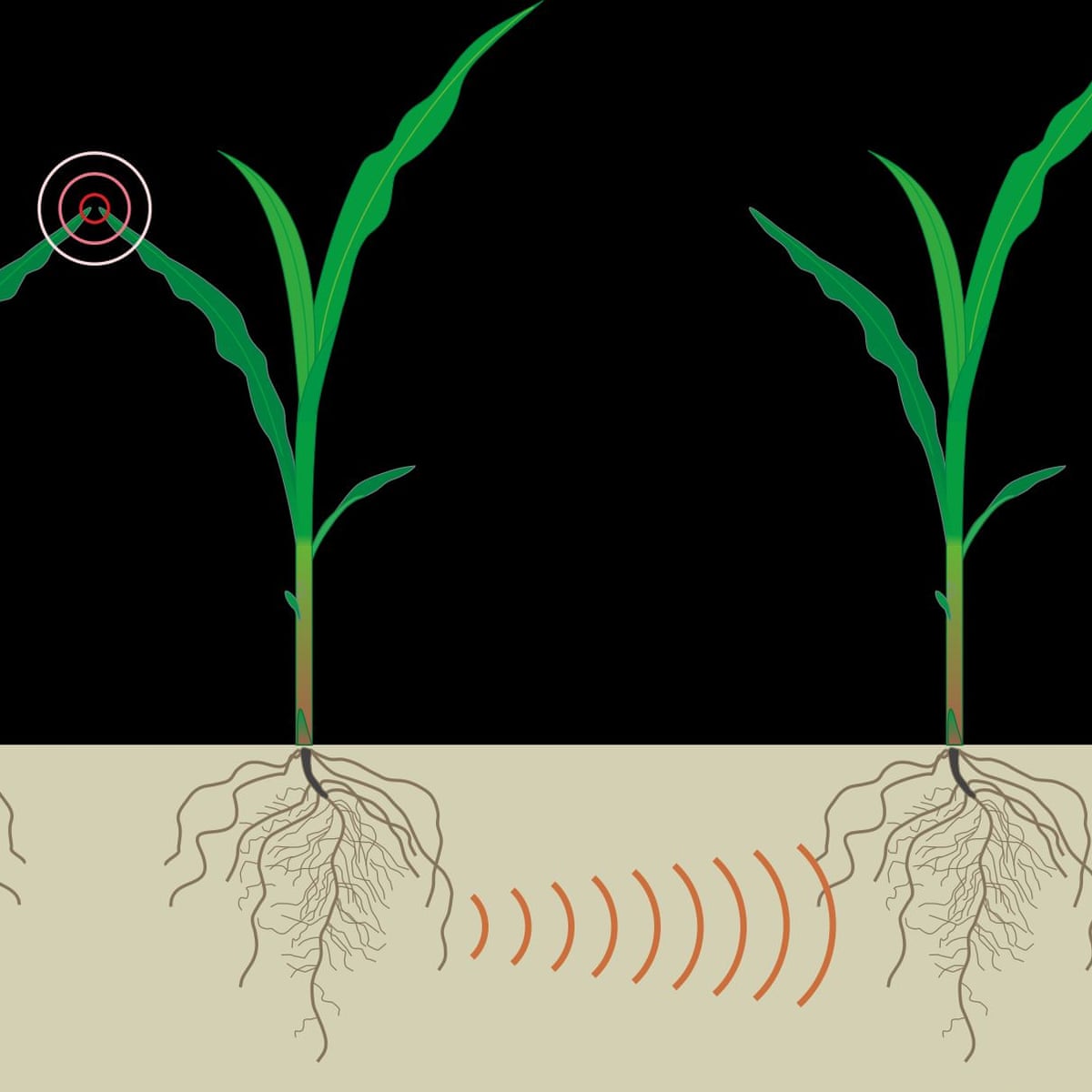
“Plants ‘talk to’ each other through …” from www.theguardian.com and used with no modifications.
Internal communication is impressive, but the real revelation in plant science is what happens between separate, unconnected plants. The primary medium for this external communication is chemistry — specifically, a sophisticated vocabulary of airborne molecules that plants release and receive with remarkable precision.
If you’ve ever walked through a freshly mowed lawn and caught that sharp, green scent, you’ve experienced this firsthand. That smell is a cocktail of volatile organic compounds (VOCs) — a distress broadcast from grass cells being torn apart. You received the message. You just didn’t know what to do with it. Nearby plants, however, do.
Volatile Organic Compounds: Airborne Warning Signals
When a plant is under attack from herbivores or pathogens, it can release a highly specific blend of VOCs into the surrounding air. These aren’t generic alarm signals — research has shown that the chemical composition of these VOC blends can vary depending on the specific attacker. A plant being eaten by a caterpillar releases a different chemical signature than one being attacked by spider mites. Neighboring plants that detect these airborne signals can actually identify the nature of the threat and prepare an appropriately tailored defense — before the attacker ever reaches them.
Studies published in peer-reviewed literature have observed neighboring plants ramping up their own defensive chemistry within hours of being exposed to VOC signals from attacked plants. This is not a passive reaction — it is an active, adaptive response to received information.
How Neighboring Plants Prepare for Threats Before They Arrive
The concept of “priming” is central here. When a plant receives a VOC warning from a neighbor, it enters a primed state — its defense systems are partially activated and ready to respond far more rapidly if the threat materializes. Think of it as a neighborhood watch system. One plant spots the danger, sends out the chemical equivalent of a group text, and the surrounding plants lock their doors. Research has confirmed this priming effect across multiple plant species, showing that primed plants suffer significantly less damage when attacked compared to plants that received no warning signal.
Kin Recognition: How Plants Identify and Help Their Offspring
- Plants can distinguish between their own seedlings and unrelated plants growing nearby
- When kin are detected, plants reduce their competitive root growth to avoid crowding relatives
- Chemical signals released through roots appear to carry identity information unique to each plant
- This behavior has been observed in species including Cakile Edentula (sea rocket) and several grass species
Kin recognition in plants is one of the most quietly astonishing discoveries in modern botany. Plants, which we typically imagine competing fiercely for every available resource, will actually pull back their root expansion when they detect a genetic relative in the soil nearby. The mechanism behind this appears to involve chemical signals secreted through root exudates — essentially a molecular fingerprint that other plants of the same species can detect and interpret. Susan Dudley at McMaster University was among the first researchers to document this behavior systematically, finding that Cakile Edentula plants growing alongside strangers produced significantly more root mass than those growing beside their siblings.
The implications of this behavior go well beyond curiosity. It suggests that plants have evolved a form of social awareness — a capacity to adjust their own behavior based on who their neighbors are. When surrounded by kin, plants appear to shift from a competitive strategy toward something closer to cooperation, allowing shared resources to stretch further across a related group. This is evolutionary logic in action: helping your genetic relatives survive increases the likelihood that shared genes are passed on, even if you personally produce fewer seeds as a result. For more on this topic, explore our urban greening guide.
What researchers are still working to understand is precisely how detailed this chemical identity system is. Can plants distinguish between a first-generation sibling and a more distant relative? Do different species respond to kin signals differently? These are open questions, but the direction of the evidence suggests that plant social behavior is considerably more nuanced than anyone anticipated even two decades ago. For those interested in enhancing their garden’s biodiversity, exploring companion planting ideas can be a great start.
The Wood-Wide Web: Underground Plant Communication
“Wood Wide Web: The underground network …” from boscum.com and used with no modifications.
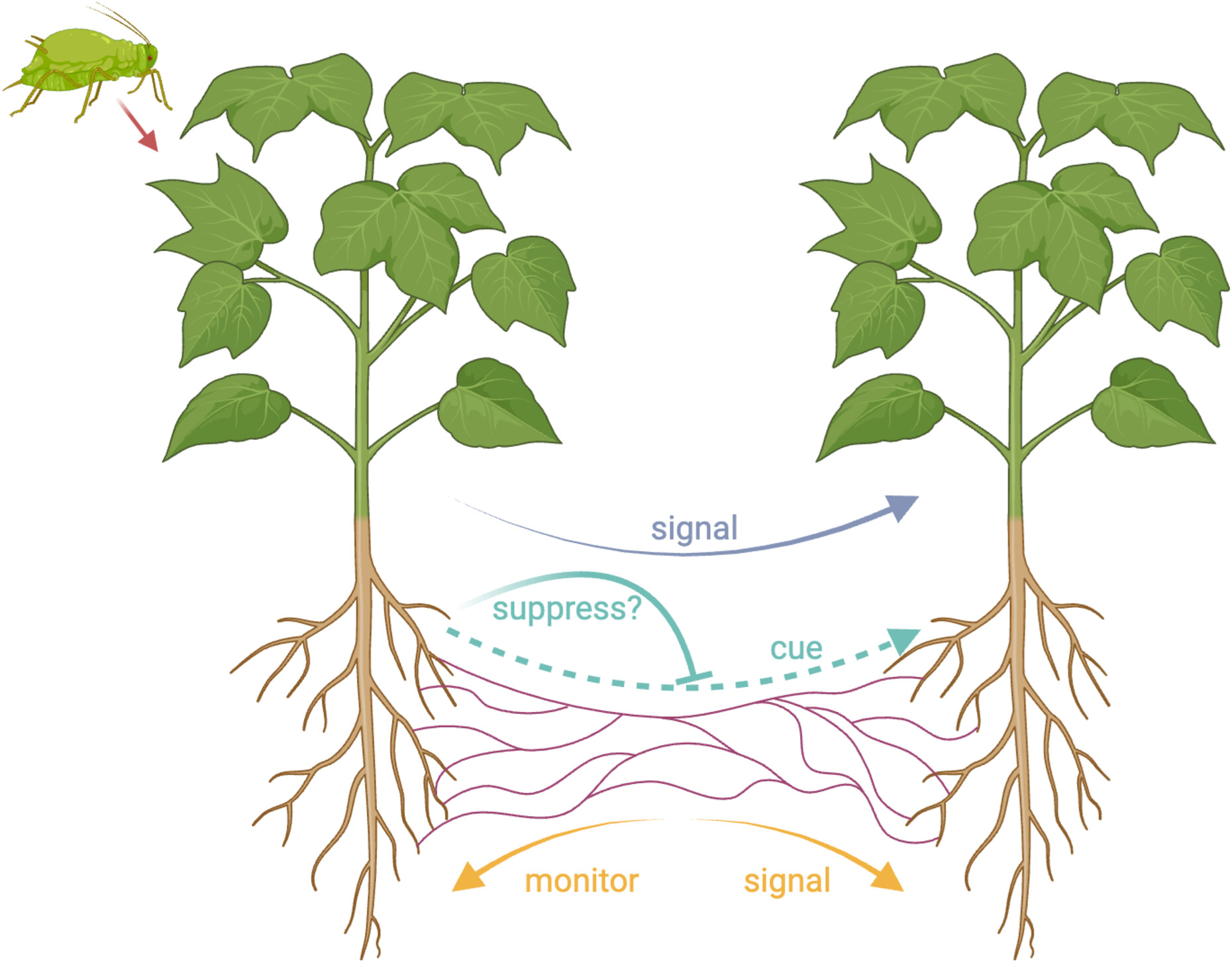
Beneath the forest floor, running through nearly every teaspoon of healthy soil, is a web of fungal threads so dense and extensive that scientists have nicknamed it the Wood-Wide Web. This underground network, built from mycorrhizal fungi, physically connects the root systems of different plants and trees, creating a living infrastructure through which nutrients, water, chemical signals, and even carbon can travel between organisms that have no direct physical contact with each other. It is, in every practical sense, a biological internet — and it has been operating for hundreds of millions of years.
The relationship between plants and mycorrhizal fungi is a mutual one. Fungi colonize plant roots and extend their thread-like hyphae far beyond where the plant’s own roots could reach, dramatically expanding the plant’s access to water and minerals like phosphorus. In exchange, the plant feeds the fungi with sugars produced through photosynthesis. This partnership is so ancient and so widespread that an estimated 90% of all land plant species participate in some form of mycorrhizal relationship.
How Mycorrhizal Fungi Connect Plants Across a Forest
The fungal threads, called hyphae, don’t stop at one plant’s roots — they continue outward and connect with the roots of neighboring plants, sometimes linking dozens or hundreds of individual trees into a single continuous network. In old-growth forests, the largest and oldest trees — sometimes called “mother trees” by researchers like Suzanne Simard at the University of British Columbia — appear to act as central hubs in this network, connected to hundreds of younger trees around them. Simard’s landmark research demonstrated that these hub trees actively channel carbon through the fungal network to shade-stressed seedlings growing in low-light conditions beneath the forest canopy, effectively subsidizing the survival of the next generation.
What Plants Trade Through the Fungal Network
The fungal network is not just a passive pipeline — it carries a remarkable range of materials and signals between connected plants. Carbon sugars flow from photosynthetically productive plants to those in shade. Phosphorus and nitrogen move from nutrient-rich zones to depleted ones. Defense signals — the chemical equivalent of a distress call — can travel through the network when one plant is under attack, triggering defensive responses in connected neighbors even when no airborne VOCs are present. There is also emerging evidence that plants can send allelopathic chemicals through the network to suppress the growth of competing, unrelated plants — a form of underground biochemical warfare that benefits the connected community at the expense of outsiders.
The Ultrasonic Sounds Stressed Plants Make
In March 2023, a study published in the journal Cell confirmed something that would have seemed impossible just a decade earlier: plants under stress produce ultrasonic clicking sounds, typically in the frequency range of 20 to 100 kilohertz — well above the threshold of human hearing, but well within the range detectable by many insects, bats, and other animals. Researchers at Tel Aviv University recorded these sounds from tomato and tobacco plants experiencing drought stress and physical damage, finding that stressed plants produced significantly more sounds than undisturbed ones, and that the acoustic patterns differed depending on the type of stress the plant was experiencing. For those interested in maintaining a healthy garden, understanding these stress signals can be as crucial as choosing the best planting supplies.
Which Plants Produce Sounds and What Triggers Them
Plant Species Stress Trigger Sound Frequency Sounds Per Hour (Approx.) Tomato (Solanum lycopersicum) Drought 20–100 kHz Up to 35 Tobacco (Nicotiana tabacum) Stem cutting 20–100 kHz Up to 15 Wheat (Triticum aestivum) Drought 20–100 kHz Elevated vs. control Corn (Zea mays) Drought 20–100 kHz Elevated vs. control
The leading hypothesis for how these sounds are generated is cavitation — the formation and collapse of tiny air bubbles inside the plant’s water-conducting xylem vessels when they are under tension from drought stress. Each bubble collapse produces a micro-acoustic pop. Under severe drought, these events happen repeatedly and rapidly enough to generate a detectable acoustic signature. Physical damage, like a stem being cut or a leaf being torn, triggers a different pattern of sounds, suggesting that the acoustic output carries information about the nature and severity of the stress.
What remains an open and genuinely exciting scientific question is whether these sounds constitute intentional communication or are simply a byproduct of physical processes happening inside stressed tissue. The distinction matters enormously. If the sounds are purely mechanical, they are stress symptoms — useful for detection, but not a true language. If they carry information that other organisms have evolved to respond to, they represent an entirely new channel of plant communication that science is only just beginning to map.
Early indications suggest the latter may be closer to the truth. Machine learning models trained on acoustic recordings from the Tel Aviv University study were able to identify not just whether a plant was stressed, but what type of stress it was experiencing — with meaningful accuracy. This has opened up an entirely new field of agricultural monitoring, where listening to crops could replace or supplement traditional methods of stress detection.
How Animals Like Bats and Moths Respond to Plant Distress Calls
The ultrasonic frequency range in which plants produce their stress sounds overlaps significantly with the hearing ranges of several ecologically important animals. Bats, which use echolocation in similar frequency ranges, may be receiving and processing plant acoustic signals as part of their environmental awareness. More directly relevant are certain moth species — some of which have been observed laying fewer eggs on plants that are producing stress sounds, apparently detecting the acoustic signal as an indicator that the plant is already compromised and therefore a suboptimal host for their larvae. This is a remarkable example of interspecies communication driven by plant output, and it illustrates that plant sounds may have shaped animal behavior over evolutionary time in ways researchers are only beginning to understand. For more insights on how plants can influence their surroundings, explore our pollen-free garden success tips.
How Flowers Communicate With Pollinators
Not all plant communication is about danger and defense. Flowers are arguably the most visible and deliberate communication system in the plant kingdom — a highly evolved broadcast designed to attract specific pollinators with extraordinary precision. Color, shape, scent, temperature, and even electrical charge all play roles in this exchange. Bees, for example, can detect weak electrical fields produced by flowers, and research from the University of Bristol has shown that bees use this electrostatic information — combined with color and scent — to identify which flowers have recently been visited and had their nectar depleted, saving the bee time and the plant from repeated unproductive visits.
Scent is perhaps the most complex floral communication channel. Some plants produce VOC blends so precisely calibrated that they mimic the pheromones of specific female insects, effectively deceiving male insects into attempting to mate with the flower and inadvertently transferring pollen in the process. Certain orchid species have taken this strategy to an extreme level of specificity, with each species producing a chemical signature that attracts only a single insect species — a relationship so tightly co-evolved that the extinction of one would likely doom the other.
Real-World Benefits of Plant Communication Research
The science of plant communication is not confined to academic journals and forest research stations — it is actively being translated into practical tools and strategies with significant real-world impact. From precision agriculture to forest conservation, understanding how plants send and receive signals is opening up new possibilities that could not have been imagined even twenty years ago.
Diagnosing Plant Stress Without Physical Contact
The acoustic research coming out of Tel Aviv University has a direct agricultural application that is already attracting serious investment and attention. If stressed plants produce distinct, measurable ultrasonic signatures depending on whether they are experiencing drought, pathogen attack, or physical damage, then arrays of ultrasonic sensors deployed across a crop field could theoretically detect stress events in real time — before any visible symptoms appear on the plant. Visible wilting, yellowing, or lesions are late-stage stress indicators. By the time a farmer sees them, significant damage has already been done. Acoustic and VOC-based detection systems could push that intervention window back by days, or even weeks.
Research groups are currently developing sensor arrays that can monitor VOC emissions from crop plants continuously, building chemical profiles that change in predictable ways as specific threats develop. Paired with machine learning models trained to recognize these chemical and acoustic signatures, these systems could send a farmer an alert the moment a particular section of a field begins broadcasting distress, identifying not just that something is wrong, but what the specific problem is. This is a fundamental shift from reactive to predictive agriculture, and plant communication science is the foundation on which it is built.
Implications for Feeding a Growing Global Population
Beyond stress detection, understanding plant communication has implications for how crops are designed, planted, and managed at a systemic level. If priming — the process by which plants exposed to VOC warnings ramp up their defenses before an attack arrives — can be reliably triggered artificially, it opens the door to reducing pesticide use significantly. Instead of blanket chemical applications, farmers could potentially use targeted VOC treatments to prime entire fields, letting the plants’ own defense systems do the work. Research has already demonstrated this principle in controlled settings with species including lima beans, maize, and wheat.
Mycorrhizal network research is also reshaping thinking around soil management. Industrial agriculture has spent decades applying practices — deep tilling, heavy fungicide use, monoculture planting — that are now understood to devastate mycorrhizal networks and effectively disconnect plants from the communication and resource-sharing infrastructure they evolved to depend on. Regenerative agriculture approaches that protect soil fungal communities are not just philosophically appealing; they are scientifically supported by a growing body of evidence showing that plants in intact mycorrhizal networks are more stress-resistant, more resource-efficient, and more productive than those growing in degraded soil. At a time when global food security faces mounting pressure from climate change, this knowledge is not optional — it is critical.
Plant Communication Is Rewriting What We Know About Nature

Every new discovery in this field forces a quiet but significant revision of assumptions that run very deep in both science and culture. The idea that plants are passive, silent, and essentially inert — scenery rather than participants — has been dismantled piece by piece over the past three decades. What has replaced it is a picture of organisms that are dynamically aware of their environment, responsive to their neighbors, and capable of behaviors that, in any animal, we would not hesitate to call sophisticated. They warn each other. They recognize their relatives. They share food with their struggling offspring through underground networks. They call for help when under attack — and other species answer.
None of this requires us to claim that plants are conscious in the way animals are, or that they experience the world subjectively. What it does require is intellectual honesty about the complexity of what is happening in any patch of soil or stand of trees. The next time you walk past a garden or step into a forest, the right mental model is not one of quiet stillness. It is one of constant, multilayered, chemically rich conversations — happening at speeds and in dimensions that human senses simply were not built to perceive. For those interested in urban gardening, exploring companion planting ideas can enhance this complex interaction.
Frequently Asked Questions
The science of plant communication raises questions that range from the deeply practical to the genuinely philosophical. Here are the most common ones, answered directly. For those interested in further exploring plant interactions, our urban greening guide offers companion planting ideas that highlight how plants can benefit from each other.
Can plants actually hear sounds from other plants?
Plants can detect and respond to airborne vibrations, including sounds produced by other plants or by feeding insects. Research has shown that plants like Arabidopsis thaliana respond differently when exposed to the sound frequencies produced by a caterpillar chewing on leaves — even when the caterpillar itself is not present — compared to plants exposed to silence or irrelevant sounds. Whether this constitutes “hearing” in a meaningful sense is a matter of definition, but the detection and response are real and measurable.
The ultrasonic sounds documented in the 2023 Cell study add another dimension to this question. If stressed plants produce sounds in the 20 to 100 kHz range and nearby organisms — including possibly other plants — respond to those sounds, then acoustic communication between plants is at minimum a plausible and actively investigated hypothesis. The honest answer right now is: detection of sound-like vibrations is confirmed; intentional acoustic communication between plants is still being established.
Do plants communicate faster when under attack?
Yes — speed is one of the most important features of plant stress communication. Electrical signals can travel through a plant’s vascular system within seconds of a wound occurring, triggering immediate local chemical responses. Airborne VOC signals begin to be released within minutes of an attack and can reach neighboring plants quickly, depending on wind conditions. The entire sequence from injury to neighboring plant defense activation can occur within a timeframe of minutes to a few hours — fast enough to be ecologically meaningful in real attack scenarios.
Can gardeners use plant communication to improve their garden?
Practically speaking, yes — and in several ways that are well supported by the science. Companion planting, which involves growing certain plant species in close proximity, is one of the most accessible applications. Plants like basil, marigolds, and certain herbs release VOCs that can prime the defenses of nearby vegetable plants, and some of these companion species also attract predators of common pests. Maintaining healthy mycorrhizal networks in garden soil by minimizing tilling, avoiding broad-spectrum fungicides, and incorporating organic matter is another direct application of Wood-Wide Web research.
Inoculating soil with commercially available mycorrhizal fungi products when planting is a practice backed by solid research, particularly in soils that have been disturbed or degraded. Products containing species like Rhizophagus Irregularis have shown measurable benefits in plant establishment and stress resistance in peer-reviewed studies. For gardeners, the practical takeaway from plant communication science is to think less about individual plants and more about the community and the soil ecosystem they are embedded in — because that ecosystem is actively supporting the plants in ways that isolated growing conditions simply cannot replicate.
Do all plants use the Wood-Wide Web underground network?
Not all plants participate in mycorrhizal networks equally. An estimated 90% of land plant species form mycorrhizal associations of some kind, making it the dominant condition rather than the exception. However, some plant families — including the Brassicaceae family, which contains cabbage, broccoli, mustard, and Arabidopsis — do not form standard mycorrhizal relationships. Plants growing in very degraded, heavily tilled, or chemically treated soils may also be effectively disconnected from functional networks even if they would otherwise participate, because the fungal communities required to build those networks have been destroyed. The Wood-Wide Web is real and pervasive, but it is not universal, and its health depends entirely on the health of the soil it lives in.
How do scientists measure or detect plant communication?
Researchers use several complementary methods to study plant communication, each suited to detecting different signal types. VOC emissions are typically captured using solid-phase microextraction or dynamic headspace sampling, then analyzed using gas chromatography-mass spectrometry (GC-MS) to identify and quantify the specific chemical compounds a plant is releasing. This allows researchers to build detailed chemical profiles of plant stress responses and track how neighboring plants respond to specific VOC blends.
Electrical signals within plants are measured using electrodes placed directly on plant tissue — similar in principle to an electrocardiogram for animals — with fluorescent calcium markers increasingly used to visualize signal propagation in real time without physical interference. Mycorrhizal network communication is studied using radioactive or stable isotope tracers, particularly carbon-13 and phosphorus-32, which can be introduced to one plant and tracked as they move through fungal connections to neighboring plants. Acoustic emissions are captured using highly sensitive ultrasonic microphones and analyzed using audio processing software, with machine learning models increasingly used to classify and interpret the resulting data.