- Chicago urban gardens do more than grow food — they actively reduce neighborhood temperatures through evapotranspiration, shade, and soil moisture retention.
- Green roofs can lower roof surface temperatures by 3 to 4 degrees Celsius (5.4 to 7.2°F), according to a collaboration between the University of Notre Dame and the City of Chicago.
- The Urban Heat Island effect hits Chicago’s South and West Sides hardest — the same neighborhoods where community gardens are creating the most meaningful change.
- There’s an unexpected trade-off: cooling the city too effectively can reduce the Lake Michigan breeze and affect vertical air mixing — a nuance most people never hear about.
- Organizations like Urban Growers Collective and Windy City Harvest are turning community gardens into engines for food justice, health equity, and climate resilience all at once.
Chicago’s urban gardens are doing something remarkable — and most people walk right past them without realizing it.
Every raised bed, rooftop planting, and community garden plot scattered across the city is quietly fighting back against one of urban life’s most persistent problems: dangerous heat. The connection between green space and city temperatures is well-documented, but in Chicago, the stakes are especially high. The city has invested heavily in green infrastructure, and the science backing it up is both specific and compelling. Urban Growers Collective, one of Chicago’s leading urban agriculture nonprofits, is a strong example of how gardens can anchor entire communities while delivering real environmental results.
Chicago’s Urban Gardens Are Quietly Changing the City’s Climate
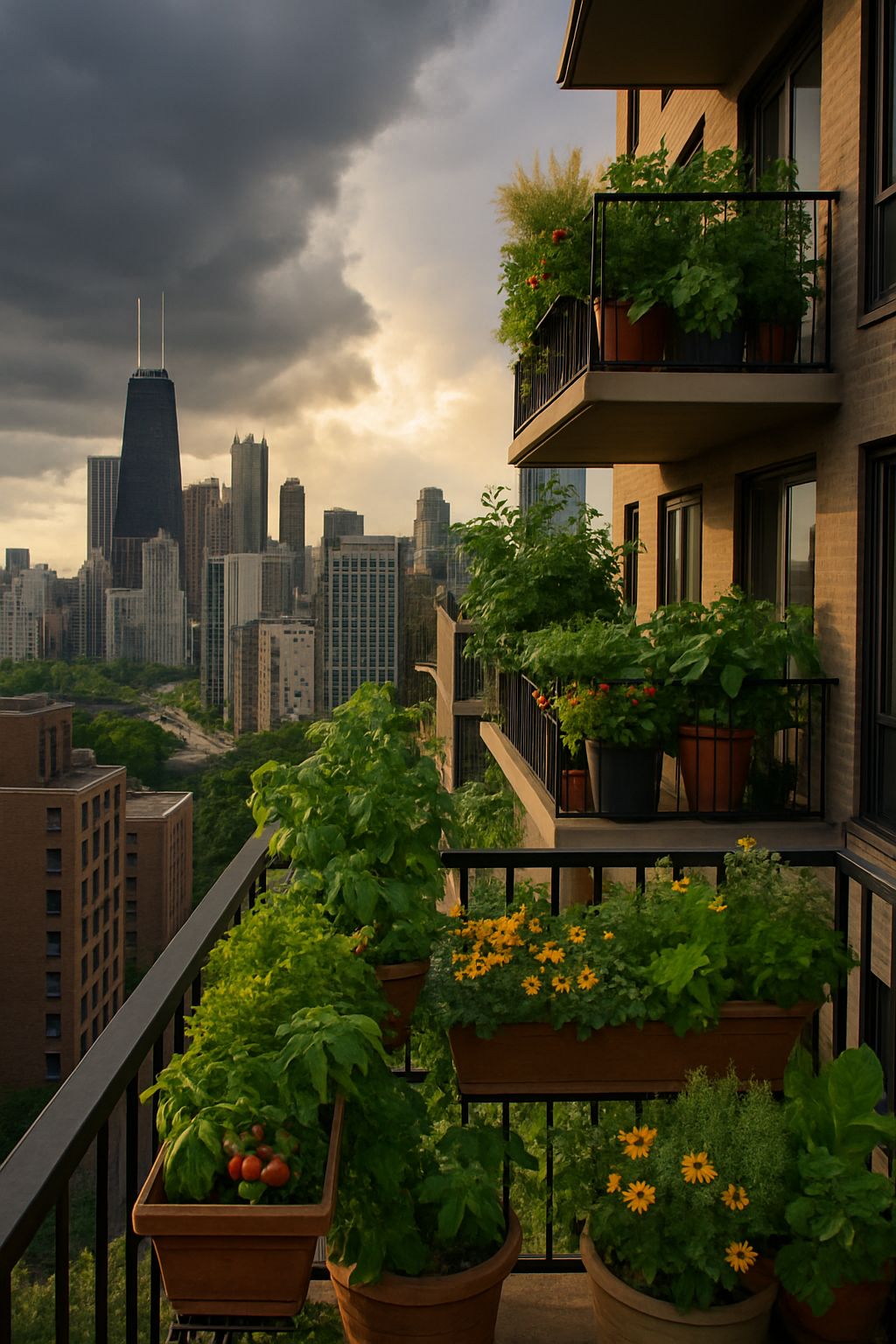
Walk through North Lawndale or Englewood on a summer afternoon and you’ll notice something immediately: the blocks with gardens feel different. The air is slightly cooler, there’s more shade, and the oppressive heat radiating off concrete and asphalt is interrupted by patches of living green. This isn’t just a feeling — it’s physics.
Urban gardens interrupt the cycle of heat absorption that defines city environments. Where pavement bakes under the sun and releases stored heat well into the night, vegetated surfaces do the opposite. They absorb sunlight but convert much of that energy into water vapor through evapotranspiration rather than radiating it back as heat. The result is measurable, localized cooling that benefits everyone nearby. For more insights on the benefits of gardening, explore gardening benefits and nature connection tips.
The Urban Heat Island Effect: Why Chicago Gets So Hot
The Urban Heat Island (UHI) effect is the reason Chicago summers feel so much more brutal than nearby rural areas. As cities grow and urbanization replaces natural land cover with roads, parking lots, and buildings, those hard surfaces absorb and trap solar radiation. By 2050, an estimated 70% of the world’s population will live in urban areas — meaning the UHI problem will only intensify without deliberate intervention.
In Chicago specifically, the UHI effect isn’t just uncomfortable. It’s a public health threat. Extreme heat events are the leading weather-related cause of death in the U.S., and dense urban environments amplify that danger. The city’s infrastructure — miles of dark asphalt, flat commercial rooftops, and minimal tree canopy in certain neighborhoods — creates pockets of extreme heat that persist long after sunset.
How Concrete and Asphalt Trap Heat in the City
Hard surfaces like asphalt and concrete have high thermal mass and low albedo — meaning they absorb a large percentage of incoming solar radiation and hold onto it. Unlike soil or vegetation, these materials don’t cool through evaporation. They simply store heat during the day and release it slowly at night, keeping neighborhoods warm around the clock during summer months.
The density of these surfaces in Chicago’s urban core creates a compounding effect. Rooftops, roads, and parking structures all contribute simultaneously. There’s very little natural water cycling happening, no canopy to intercept sunlight, and no soil to buffer temperature swings. The city essentially becomes a slow-release heat battery, highlighting the need for pollinator-friendly shade garden ideas in Chicago.
- Dark asphalt can reach surface temperatures of 150°F (65°C) on hot summer days
- Urban areas can be 1 to 7°F warmer than surrounding rural areas on average
- Nighttime temperatures in urban cores often stay 5 to 10°F higher than rural areas due to stored heat release
- Buildings and roads replace the natural water cycle, eliminating the cooling effect of evaporation from soil and plants
- Waste heat from vehicles, air conditioning units, and industry adds additional thermal load to city streets
Why Chicago’s South and West Sides Feel It Most
Not all Chicago neighborhoods experience the heat equally. The South and West Sides — communities like Englewood, Austin, and Pilsen — have historically had less tree canopy coverage, more paved surface area, and fewer parks per capita than wealthier North Side neighborhoods. This disparity maps almost perfectly onto existing patterns of disinvestment and environmental injustice. The residents most exposed to dangerous heat are often the same communities with the least access to air conditioning, green space, and health resources.
How Urban Gardens Actually Cool a Neighborhood
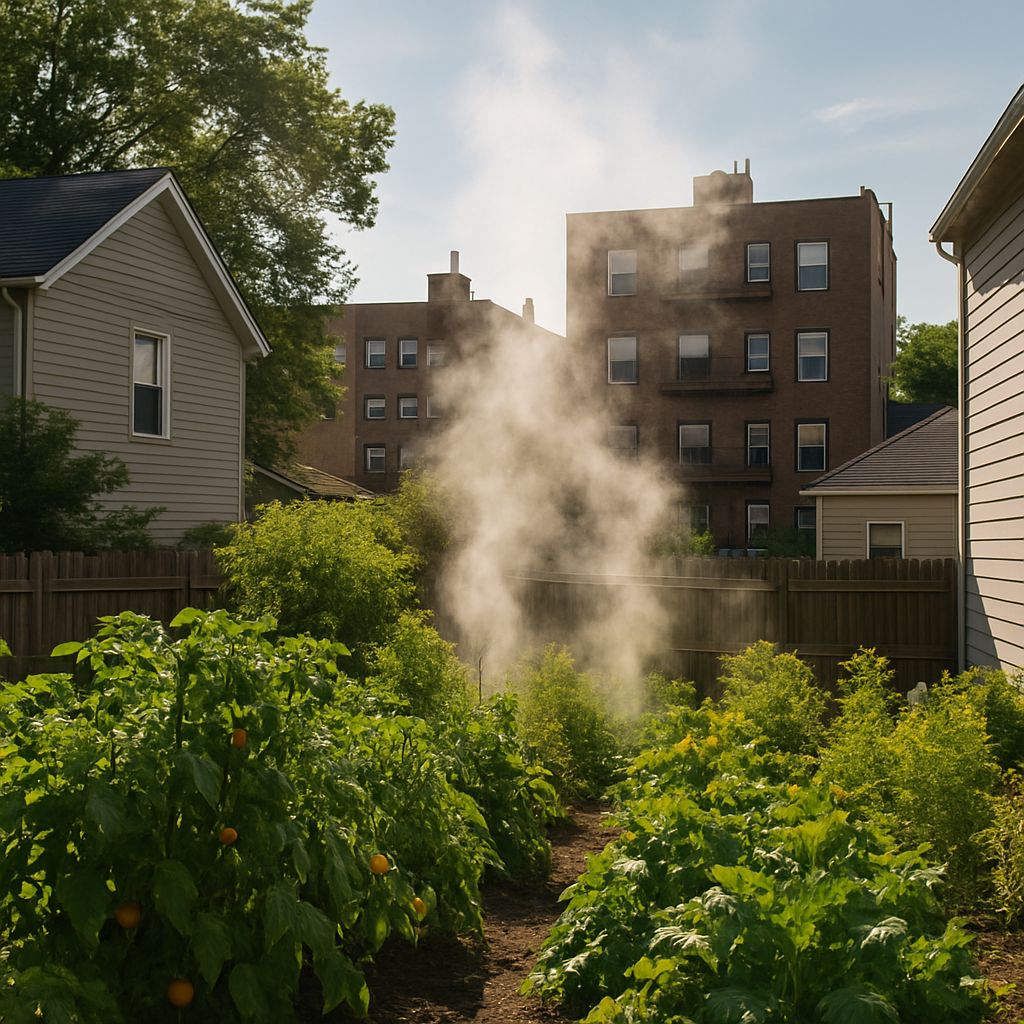
Urban gardens cool their surroundings through three distinct but interconnected mechanisms: evapotranspiration, physical shade, and soil moisture retention. Each one contributes to lowering both surface temperatures and ambient air temperatures, making the blocks around a garden noticeably more livable during peak summer heat. For more on maintaining these green spaces, check out this sustainable urban garden maintenance guide.
Evapotranspiration: Nature’s Built-In Air Conditioner
Evapotranspiration (ET) is the combined process of water evaporating from soil and transpiring through plant leaves. It’s the primary reason a park feels cooler than a parking lot. As plants draw water from the soil and release it through their leaves, that phase change from liquid to vapor absorbs heat energy from the surrounding air — functioning almost exactly like the cooling coils in an air conditioner, just powered by sunlight and soil moisture.
In a dense urban garden with healthy soil and full plant coverage, ET rates can be surprisingly high. The more diverse and productive the garden — with a mix of leafy vegetables, fruit plants, and ground cover — the more cooling surface area is actively working. A well-managed community garden plot isn’t just producing food; it’s running a continuous, low-energy cooling process for the surrounding block.
Shade Coverage and Surface Temperature Reduction
Physical shade from garden structures, trellised plants, and tree canopy directly reduces the amount of solar radiation hitting the ground. Shaded surfaces can be dramatically cooler than exposed pavement — sometimes 20 to 45°F lower in direct surface temperature. That difference translates into less heat radiating back into the surrounding air, creating a cooler microclimate at street level where people actually live and move.
The Role of Soil Moisture in Cooling the Air Around It
Moist soil acts as a natural temperature buffer. Wet soil requires significant energy to heat up compared to dry pavement, and as it slowly releases moisture into the air, it maintains a cooling effect that extends beyond the garden’s physical boundaries. Even a modest community garden with consistently watered beds contributes a measurable buffer against the heat radiating from surrounding concrete and asphalt. For more on creating effective garden spaces, explore these pollinator-friendly shade garden ideas.
Green Roofs vs. Cool Roofs: What the Research Says

When it comes to tackling Chicago’s UHI effect from above, two approaches dominate the conversation: green roofs, which are covered with vegetation and growing media, and cool roofs, which use highly reflective materials to bounce solar radiation back into the atmosphere rather than absorbing it. Both strategies work, but they work differently — and a landmark study out of the University of Notre Dame, conducted in collaboration with the City of Chicago, put hard numbers on just how effective each can be. For those interested in sustainable urban gardening, here’s a guide to urban garden maintenance that complements these roofing strategies.
University of Notre Dame Findings on Roof Temperature Reduction
The Notre Dame and City of Chicago collaboration used a regional climate model to simulate various real-world urban rooftop conditions across the city. The results were specific and actionable: replacing conventional rooftops with either green or cool roof surfaces could reduce roof temperatures by 3 to 4 degrees Celsius (5.4 to 7.2 degrees Fahrenheit). That may sound modest, but at a city-wide scale, that temperature reduction cascades into measurable drops in ambient air temperature, reduced energy demand for cooling, and lower heat-related health risks.
- Green roofs cool through evapotranspiration from vegetation and growing media — active biological cooling
- Cool roofs cool through high solar reflectance — bouncing sunlight away before it becomes heat
- Both approaches reduced roof surface temperatures by 3 to 4°C in the Notre Dame simulation
- The study modeled conditions across Chicago’s existing infrastructure footprint, making results directly applicable to the city
- Green roofs provide additional co-benefits: stormwater management, biodiversity habitat, and potential food production
What makes this research particularly valuable is that it wasn’t theoretical. The team simulated actual Chicago rooftop coverage scenarios, giving city planners real data to work with rather than generalized estimates. The findings helped validate Chicago’s ongoing investment in green infrastructure as a climate strategy, not just an aesthetic one. For those interested in exploring more about urban gardening in Chicago, check out these pollinator-friendly shade garden ideas.
The practical takeaway for building owners and urban gardeners alike is significant. Every rooftop converted to a green surface — even a modest one with container gardens and a layer of growing media — contributes to a cumulative cooling effect across the city. Individual actions aggregate into neighborhood-scale results.
How Green Roofs Fit Into Chicago’s 2040 Green Infrastructure Vision
Chicago’s Green Infrastructure Vision, developed through the Chicago Wilderness coalition, outlines a long-range framework for expanding and connecting natural areas, green corridors, and vegetated surfaces across the greater Chicago region through 2040. Green roofs are a core component of that vision, particularly in the dense urban core where ground-level green space is limited. The strategy recognizes that vertical and horizontal greening — from street trees to rooftop gardens — must work together to achieve meaningful climate resilience.
The vision specifically targets connectivity between green spaces, understanding that isolated patches of vegetation have limited impact compared to linked corridors of green infrastructure. A rooftop garden in the Loop, a community garden in Pilsen, and a bioswale in Bronzeville aren’t just individual projects — they’re nodes in a larger living network designed to cool, filter, and sustain the city’s environment across decades.
The Lake Breeze Effect: An Unexpected Consequence of Cooling the City
Here’s where the science gets genuinely fascinating — and a little counterintuitive. Chicago’s famous lake breeze from Lake Michigan is driven by a temperature-pressure differential: the relatively cool air over the lake pushes inland to replace the warmer, rising air over the hot city. It’s a natural ventilation system that millions of Chicagoans depend on for relief during heat waves. For those looking to enjoy the outdoors during these cooler breezes, consider allergy-free cycling gear to enhance your experience.
The Notre Dame research revealed an unexpected wrinkle: as green and cool roofs reduce the city’s overall temperature, they also reduce that pressure differential between the lake and the urban core. A cooler city creates less of a draw for the lake breeze, meaning widespread green roof adoption could actually decrease the frequency and strength of the lake breeze penetrating Chicago neighborhoods.
The Trade-Off in Plain Terms: Green roofs cool rooftops directly but may reduce the natural lake breeze that cools street-level residents. The net benefit still favors green infrastructure — but urban planners need to account for this dynamic when modeling city-wide cooling strategies. Localized garden cooling at street level becomes even more important as a complement to rooftop greening.
This finding doesn’t undermine the case for urban gardens and green roofs — the overall cooling effect remains strongly positive. But it does highlight why a layered approach matters. Rooftop greening alone isn’t sufficient; street-level gardens, the tree canopy, and green corridors need to work in parallel to deliver cooling benefits at ground level, where people actually experience the heat.
For urban gardeners, this is actually an empowering insight. The community garden you tend in your neighborhood isn’t just a supplement to larger infrastructure projects — it’s an essential part of the cooling system in its own right, delivering ground-level evapotranspiration and shade that rooftop strategies can’t fully replace. To learn more about effective planting, explore our Chicago shade plants guide.
Air Quality Risks When Vertical Air Mixing Decreases
The same Notre Dame research flagged another nuanced concern: when UHI intensity decreases, the vertical mixing of air in the atmosphere can also decrease. Urban heat islands actually drive upward air movement that helps disperse ground-level pollutants — vehicle exhaust, industrial emissions, particulate matter — by pushing them higher into the atmosphere. A cooler, more stable urban atmosphere may trap those pollutants closer to street level, potentially offsetting some of the health gains from temperature reduction. This isn’t a reason to stop greening the city — it’s a reason to pursue parallel reductions in vehicle and industrial emissions alongside green infrastructure investment.
Neighborhood Impact Beyond Temperature
Temperature reduction is the headline benefit, but Chicago’s urban gardens deliver a much wider range of neighborhood impacts that compound over time. Green space access is directly linked to physical health outcomes, mental health, community cohesion, and economic stability — all of which are unevenly distributed across the city in ways that mirror the UHI disparity.
The neighborhoods that run the hottest in summer are frequently the same neighborhoods with the highest rates of diet-related illness, the lowest access to fresh produce, and the fewest community gathering spaces. Urban gardens address all of these problems simultaneously, which is why organizations working at the intersection of food justice and climate resilience have found such fertile ground in Chicago’s South and West Sides.
Food Access and Food Justice on Chicago’s South and West Sides
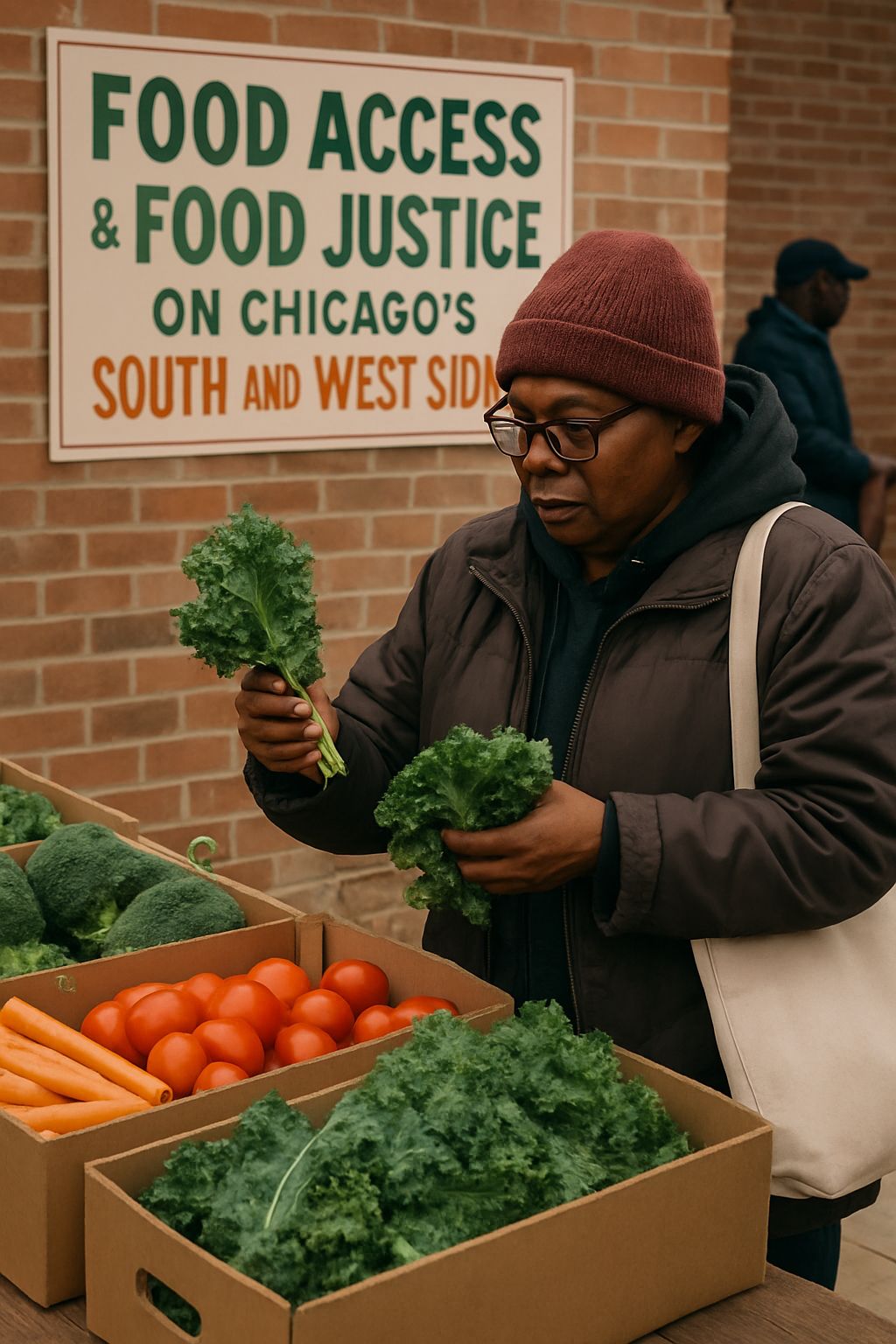
Large stretches of Chicago’s South and West Sides qualify as food deserts — areas where residents lack reliable access to affordable, nutritious food within a reasonable distance. Community gardens and urban farms in these neighborhoods don’t just grow vegetables; they directly challenge the food access gap that has persisted for decades, as grocery stores and fresh food retailers have disproportionately avoided lower-income areas of the city.
Urban Growers Collective operates multiple urban farms on Chicago’s South and West Sides, producing tens of thousands of pounds of fresh produce annually and distributing a significant portion to community members at low or no cost. Their work demonstrates that urban agriculture at a meaningful scale is achievable in Chicago’s density — and that the environmental benefits of those farms (cooling, stormwater management, air filtration) are inseparable from the social benefits they deliver. For those interested in maintaining these spaces, here is a sustainable urban garden maintenance guide.
Community Health Outcomes Linked to Green Space Access
Access to green space is consistently associated with better physical and mental health outcomes across urban populations. Residents who live near parks, gardens, and tree canopy report lower stress levels, higher rates of physical activity, and better overall well-being compared to residents in comparable neighborhoods with minimal green space. In the context of Chicago’s heat-vulnerable communities, these benefits aren’t abstract — they translate into real reductions in heat-related illness, emergency room visits, and chronic disease burden.
Children in neighborhoods with community gardens show measurable improvements in healthy eating behavior and physical activity. Elderly residents — one of the most heat-vulnerable populations — benefit from both the cooler microclimates gardens create and the social connection that community gardening fosters. Isolation is a major risk factor for heat-related mortality, and gardens naturally draw people together.
The mental health dimension is equally important and often underappreciated. Green space exposure reduces cortisol levels, improves mood, and provides restorative environments that buffer the psychological stress of living in dense, high-noise urban environments. For communities already managing elevated stress from economic precarity and environmental hazards, neighborhood gardens offer something that can’t be replicated by infrastructure alone.
Urban Growers Collective and the Bigger Picture
Urban Growers Collective stands as one of Chicago’s most compelling examples of what urban agriculture can achieve when it’s rooted in community need rather than novelty. Founded with a specific focus on Chicago’s South and West Side communities, the organization operates across multiple farm sites, runs workforce development programs, and centers racial equity in every aspect of its work. Their farms are productive — generating meaningful volumes of fresh food — but their deeper impact is in demonstrating what community-controlled green space looks like at scale.
What Urban Growers Collective represents in the broader context of Chicago’s cooling strategy is proof that climate resilience and social equity aren’t competing priorities. Their farm sites are doing real environmental work: reducing surface temperatures, managing stormwater, building soil health, and creating green corridors in neighborhoods that have historically had almost none. Every acre they cultivate is an acre that isn’t absorbing and radiating heat back into the community. Learn more about the impact of Chicago community gardens.
How to Get Involved in Chicago’s Urban Garden Movement
Chicago has one of the most developed urban gardening ecosystems in the country, with multiple organizations, programs, and resources specifically designed to help residents get started — whether you want a small plot for personal growing or want to plug into a larger community effort with real neighborhood impact. Here’s where to begin: Chicago Community Gardens offers valuable resources and connections.
- NeighborSpace — Chicago’s urban land trust, preserving community gardens on over 100 sites across the city
- Chicago Park District Garden Program — offers garden plots at parks throughout the city at accessible rates
- Chicago Community Gardeners Association (CCGA) — provides training, resources, and community connection for garden organizers
- Windy City Harvest (Chicago Botanic Garden) — offers hands-on urban agriculture training, apprenticeship programs, and youth education
- Urban Growers Collective — workforce development, volunteer opportunities, and community farm programming on the South and West Sides
- City of Chicago Green Permit Program — offers expedited permitting and fee waivers for buildings that incorporate green roofs and other sustainable features
Getting involved doesn’t require expertise or a large commitment upfront. Many of these organizations offer single-day volunteer opportunities, free workshops, and beginner-friendly growing programs. The barrier to entry is genuinely low — what matters most is showing up.
The broader impact of your involvement accumulates faster than you might expect. A single community garden plot contributes to localized cooling, stormwater absorption, and food access simultaneously. When you connect that individual effort to a network of gardens across a neighborhood, the aggregate environmental and social impact becomes significant — and measurable.
1. Start With NeighborSpace or the Chicago Park District for Land Access
Land access is the first practical hurdle for most aspiring urban gardeners in Chicago, and both NeighborSpace and the Chicago Park District have systems in place to help. NeighborSpace holds long-term leases and ownership of community garden land across more than 100 sites, protecting those spaces from development and keeping them available for community use. Their model ensures that gardens built by community members don’t disappear when a property changes hands — a critical stability guarantee in neighborhoods experiencing development pressure.
The Chicago Park District’s garden program offers individual plots at dozens of parks citywide, typically at low annual fees. These plots are especially useful for residents who want a personal growing space without the organizational commitment of running a full community garden. Both pathways give you legal, stable access to growing space, which is the foundation on which everything else is built. For those interested in optimizing their urban gardens, exploring gardening benefits and nature connection tips can be quite beneficial.
2. Build Skills Through the Chicago Community Gardeners Association or Windy City Harvest
Once you have land access, building practical skills is what separates a struggling garden from a thriving one. The Chicago Community Gardeners Association offers workshops, peer learning networks, and direct support for community garden organizers across the city. Their programming covers everything from soil health and composting to conflict resolution within shared garden spaces — because the human dynamics of community gardening matter just as much as the horticultural ones.
Windy City Harvest, operated through the Chicago Botanic Garden, goes deeper with structured apprenticeship and certificate programs in urban agriculture. Their curriculum is hands-on and professionally oriented, designed for people who want to take urban growing seriously — whether as a community leader, a small-scale food producer, or a future urban agriculture professional. Their Youth Farm program specifically engages Chicago teenagers in paid agricultural work, building both practical skills and a genuine connection to food systems in communities where that connection has historically been severed. For tips on planting in shaded areas, check out this Chicago shade plants guide.
3. Connect With Urban Growers Collective for Community-Level Impact
If you want your gardening efforts to connect to something larger than a single plot, Urban Growers Collective is the most direct path to community-level impact on Chicago’s South and West Sides. Their volunteer programs, farm events, and workforce development initiatives welcome people at every experience level. You don’t need to be a seasoned grower to contribute meaningfully — showing up consistently, learning alongside experienced farmers, and helping distribute food to community members is valuable work that directly advances both food justice and climate resilience in neighborhoods that need it most.
Chicago Proves Urban Gardens Are More Than a Feel-Good Idea
The evidence is clear, and the examples are real. Chicago’s urban gardens are doing measurable environmental work — lowering surface temperatures, managing stormwater, building soil health, and creating green corridors in neighborhoods that have historically had almost none. The science from Notre Dame and the City of Chicago gives those efforts hard numbers: roof surface temperatures dropping 3 to 4 degrees Celsius, ambient air cooling through evapotranspiration, and a city-wide greening strategy that’s built on decades of community-level organizing and growing.
But the numbers only tell part of the story. What urban gardens actually do in Chicago is connect people to their environment in a way that nothing else quite replicates. They make climate resilience tangible, local, and actionable. Every gardener tending a plot in Englewood or Pilsen or Austin is part of a living, distributed cooling system — one that feeds people, builds community, and pushes back against the heat one square foot of living green at a time. That’s not a feel-good idea. That’s a strategy.
Frequently Asked Questions
Here are answers to the most common questions about how Chicago’s urban gardens deliver cooling benefits and broader neighborhood impact.
Do urban gardens actually lower temperatures in Chicago neighborhoods?
Yes — urban gardens lower temperatures through evapotranspiration, physical shade, and soil moisture retention. Plants release water vapor through their leaves, which absorbs heat energy from the surrounding air in the same way an air conditioner’s cooling coils work. Shaded surfaces under garden canopy can be 20 to 45°F cooler than exposed pavement, creating measurable microclimates at street level that benefit nearby residents directly.
The cooling effect is most pronounced in dense garden areas with healthy, well-watered soil and diverse plant coverage. A single garden plot contributes modestly; a network of gardens distributed across a neighborhood creates cumulative cooling that begins to offset the Urban Heat Island effect in a meaningful way. Chicago’s investment in community gardens on the South and West Sides is precisely targeted at the neighborhoods where that cooling is most urgently needed.
What is the Chicago Wilderness Green Infrastructure Vision for 2040?
The Chicago Wilderness Green Infrastructure Vision is a long-range regional framework developed through the Chicago Wilderness coalition that maps out how natural areas, green corridors, green roofs, and vegetated surfaces across the greater Chicago region should be expanded and connected through the year 2040. It treats urban greening not as a collection of isolated projects but as an interconnected network — where a rooftop garden in the Loop, a community farm in Englewood, and a restored wetland in the suburbs are all nodes in the same living system designed to cool, filter, and sustain the region’s environment for future generations.
How do green roofs differ from community gardens in terms of cooling benefits?
Green roofs cool primarily from above — they reduce the surface temperature of rooftops, which in turn reduces the heat radiating down into the building and out into the surrounding air. Community gardens cool primarily at street level, where people actually experience the heat. Green roofs are essential for addressing the UHI effect at a city-wide scale, but they don’t replace the ground-level evapotranspiration, shade, and human-scale cooling that community gardens deliver. The most effective urban cooling strategy uses both in combination, and the Notre Dame research specifically found that street-level green space becomes more important as a complement to rooftop greening, especially given the potential reduction in lake breeze that comes with widespread cool roof adoption.
Which Chicago neighborhoods benefit most from urban gardens?
Chicago’s South and West Side neighborhoods — including Englewood, Austin, North Lawndale, and Pilsen — benefit most from urban gardens both environmentally and socially. These communities experience the highest Urban Heat Island intensity due to lower tree canopy coverage, more paved surface area, and decades of disinvestment in green infrastructure. They also face the greatest food access challenges and the highest rates of heat-related health risk. Urban gardens in these neighborhoods deliver a concentrated combination of cooling, fresh food access, community health benefits, and economic opportunity that makes their impact especially significant.
Can reducing urban heat in Chicago affect air quality negatively?
This is one of the more counterintuitive findings from the University of Notre Dame’s research in collaboration with the City of Chicago. When the Urban Heat Island effect is reduced through widespread green or cool roof adoption, it can decrease the intensity of vertical air mixing in the atmosphere above the city. Urban heat islands actually drive upward air movement that helps lift and disperse ground-level pollutants — vehicle exhaust, particulate matter, and industrial emissions — higher into the atmosphere where they dilute more effectively.
A cooler, more stable urban atmosphere may allow those pollutants to remain closer to street level for longer periods, potentially creating localized air quality concerns that partially offset the health gains from temperature reduction. Researchers flagged this dynamic not as a reason to abandon green infrastructure, but as a reason to pursue emission reductions alongside greening strategies. The two interventions need to work together.
- Reduce vehicle emissions by supporting public transit use and active transportation infrastructure in greened neighborhoods
- Advocate for industrial emission controls in parallel with green roof and community garden expansion programs
- Support Chicago’s broader climate action plan, which addresses both green infrastructure and emissions reduction as integrated strategies
- Prioritize ground-level gardens and tree canopy alongside rooftop greening to maintain street-level air movement and cooling
The net health impact of urban greening in Chicago remains strongly positive — the cooling benefits, mental health gains, food access improvements, and stormwater management advantages far outweigh the nuanced air quality risk. But the research is a reminder that urban climate systems are complex, and the most effective interventions are those that account for those complexities rather than ignoring them.
Chicago is one of the most actively studied urban heat environments in the country precisely because it has so many variables at play: Lake Michigan’s moderating influence, the stark north-south disparity in green space access, a legacy of industrial land use, and a city government that has invested meaningfully in green infrastructure for decades. The lessons coming out of Chicago’s urban greening programs are directly applicable to cities across the Midwest and beyond.
Every garden planted in this city is a data point in a larger experiment — one that’s proving, season after season, that community-led green space is one of the most powerful tools available for building cities that are cooler, healthier, and more equitable. Urban Growers Collective continues to lead that work on Chicago’s South and West Sides, showing what’s possible when urban agriculture is treated not as a hobby but as infrastructure.