- True HEPA filters capture 99.97% of airborne particles as small as 0.3 microns—including pollen, pet dander, dust mites, and mold spores—making filter type the single most important factor when shopping for an allergy air purifier.
- Not all HEPA filters are equal. “HEPA-type” or “HEPA-style” filters are marketing terms that do not meet the same certified standard as True HEPA, and choosing the wrong one could leave allergens circulating in your home.
- CADR rating and room size coverage must match your space—an undersized unit running at full power still won’t clean the air fast enough to make a real difference for allergy sufferers.
- The Levoit Core 300S consistently ranks as the best overall air purifier for allergies, with 219 sq ft of coverage, three-stage filtration, and months of verified real-world performance in homes with multiple pets.
- One air purifier rarely covers an entire house—placement strategy and understanding ACH (Air Changes per Hour) matters just as much as the unit itself. We cover this in detail below.
If you suffer from allergies, the air inside your home could be making things significantly worse—and the right air purifier changes that fast.
Indoor air can contain two to five times more pollutants than outdoor air, according to the EPA. For allergy sufferers, that means invisible clouds of pollen tracked in from outside, pet dander embedded in furniture fibers, dust mite debris floating through every room, and mold spores thriving in corners you rarely think about. An air purifier doesn’t just help—it can be one of the most impactful changes you make to your indoor environment. Molekule is one resource that dives deep into the science of air purification and indoor air quality for those who want to go further.
True HEPA Filters Catch 99.97% of Allergens—Here’s What That Means for You
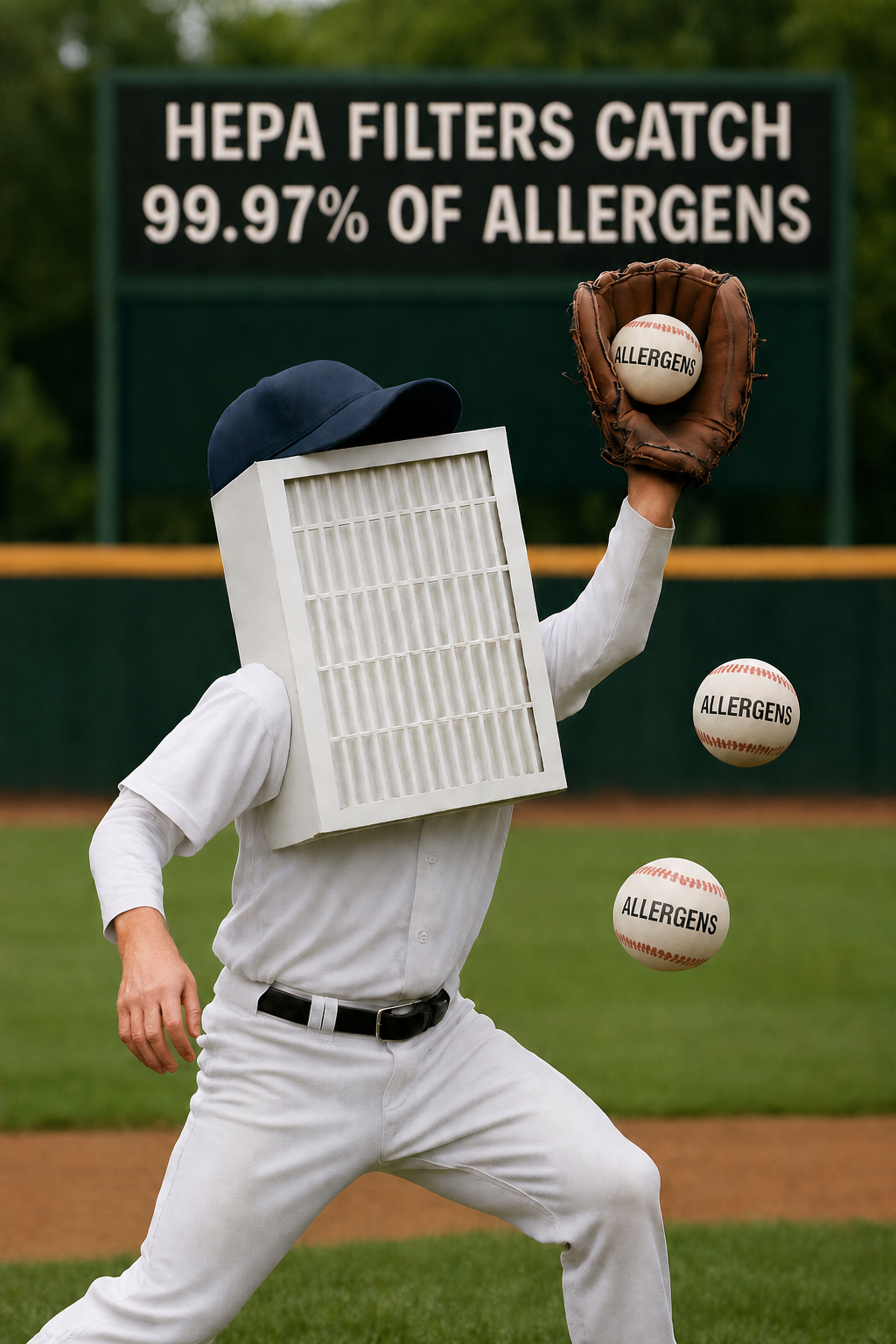
The 99.97% figure isn’t a marketing claim—it’s a certified standard set by the U.S. Department of Energy. A True HEPA filter must physically trap at least 99.97% of particles that are 0.3 microns in diameter, which happens to be the most penetrating particle size (MPPS). Particles larger and smaller than 0.3 microns are actually captured at even higher rates, which is why True HEPA is considered the gold standard for allergen removal.
To put 0.3 microns into perspective: a human hair is roughly 70 microns wide. Pollen ranges from 10 to 100 microns. Pet dander sits around 2.5 microns. Dust mite debris falls between 0.5 and 50 microns. A True HEPA filter catches all of them.
How HEPA Filtration Traps Pollen, Pet Dander, and Dust Mites
HEPA filtration works through three physical mechanisms, not just a simple mesh screen. Understanding this explains why True HEPA outperforms cheaper alternatives at every particle size range.
| Mechanism | How It Works | Best For |
|---|---|---|
| Interception | Particles following airflow come close enough to a fiber to stick to it | Mid-size particles like pet dander (2–10 microns) |
| Impaction | Larger particles can’t follow the airstream and collide directly with fibers | Pollen and dust mite debris (10+ microns) |
| Diffusion | Ultra-fine particles move erratically (Brownian motion) and collide with fibers | Fine particles under 0.1 microns |
This layered capture system is why a well-maintained True HEPA filter keeps performing effectively over time. The filter doesn’t just block—it traps, and trapped particles stay trapped.
Why Activated Carbon Filters Matter for Odor and Smoke
HEPA handles particles, but it does nothing for gases, odors, or volatile organic compounds (VOCs). That’s exactly where activated carbon steps in. Activated carbon is processed to create millions of microscopic pores that adsorb—not absorb—gas molecules, locking odors, smoke, cooking smells, and VOCs like formaldehyde onto the carbon surface. For more information on effective air filtration, check out our best HEPA air filtration systems guide.
For allergy sufferers who also deal with smoke sensitivity or chemical sensitivities, a unit with both True HEPA and a substantial activated carbon layer is non-negotiable. Thin carbon pre-filters (less than 1/4 inch thick) found in budget models offer minimal odor control. Serious odor and smoke removal requires a thicker carbon bed—look for units with at least 1 to 5 lbs of activated carbon for meaningful performance.
The Difference Between True HEPA and HEPA-Type Filters
- True HEPA: Certified to capture 99.97% of particles at 0.3 microns. Tested and verified. The only type worth using for genuine allergy relief.
- HEPA-13 or H13: A higher-grade HEPA standard, capturing 99.95% of particles at 0.1 microns—used in medical and high-sensitivity environments.
- HEPA-Type / HEPA-Style / HEPA-Like: Unregulated marketing terms. These filters may capture as little as 85–90% of particles and are not independently certified.
- Washable HEPA: Reusable but typically lose efficiency over time and can harbor mold if not dried completely between uses.
The label matters enormously. A filter marketed as “HEPA-style” on a $40 unit is not doing the same job as a certified True HEPA filter—and for allergy sufferers, that gap in performance is the difference between relief and continued symptoms.
What to Look for in an Air Purifier for Allergies
Beyond filter type, four key specifications separate genuinely effective allergy air purifiers from units that look good on paper but underdeliver in real rooms.
Clean Air Delivery Rate (CADR) Explained
CADR measures how quickly an air purifier delivers filtered air, expressed in cubic feet per minute (CFM). It’s tested and certified by the Association of Home Appliance Manufacturers (AHAM) for three specific pollutants: smoke, dust, and pollen. A higher CADR means the unit cleans air faster. As a general rule, your air purifier’s CADR for pollen should be at least two-thirds of your room’s square footage—so a 300 sq ft room needs a pollen CADR of at least 200.
Room Size Coverage and Placement Tips
Coverage ratings on the box are calculated at a single air change per hour (ACH). For allergy relief, you want at least 4–5 ACH, which means you should use a unit rated for a space roughly twice the size of the room you’re placing it in. Position the unit in a central location away from walls and furniture to maximize airflow, and keep doors and windows closed while it runs for best results. For additional tips on maintaining an allergen-free environment, check out this allergen-free herb kit checklist.
Noise Levels and Sleep Mode Features
Most air purifiers run between 25 and 65 decibels depending on fan speed. Sleep mode typically drops operation to around 25–35 dB—comparable to a quiet library. If you’re running a unit overnight in a bedroom (which is highly recommended for allergy sufferers), look for units with a dedicated sleep mode and dimming display lights to avoid sleep disruption. For those interested in creating a more allergy-friendly environment, consider exploring allergen-free herb kits to complement your air purifier.
Filter Replacement Costs and Maintenance
The purchase price is just the beginning. True HEPA filters need replacement every 6 to 12 months depending on usage and air quality conditions, and replacement filters typically cost $20 to $80 per set. Before buying any unit, calculate the annual filter cost—some budget-priced purifiers have expensive proprietary filters that push annual ownership costs well above premium models.
1. Levoit Core 400S — Best Overall Air Purifier for Allergies
The Levoit Core 400S earns the top spot because it delivers verified, real-world allergen reduction across a meaningful room size without the inflated price tag of premium brands.
Tested over months in homes with pets, smoke exposure, and high pollen seasons, the Core 400S consistently outperforms units at the same price point. Its three-stage filtration system—pre-filter, H13 True HEPA, and activated carbon—handles everything from fine pet dander to cooking odors in a single pass.
- Coverage: Up to 403 square feet (at 2x ACH for allergy performance, use in rooms up to 200 sq ft)
- CADR: 260 CFM for dust, pollen, and smoke
- Filter Type: H13 True HEPA + activated carbon + pre-filter
- Noise Level: As low as 24 dB in sleep mode
- Smart Features: Wi-Fi enabled, VeSync app compatible, auto mode with real-time air quality sensor
- Filter Replacement Cost: Approximately $25–$35 per filter set, rated for 6–8 months
The AirSight™ Plus Technology uses a laser dust sensor to detect PM2.5 particles in real time, automatically adjusting fan speed when allergen levels rise—a genuinely useful feature during high pollen days or when cooking generates smoke and VOCs. For more on preventing indoor pollen exposure, check out our guide on the best HEPA air filtration systems.
Key Specs and Filtration Performance
The H13 True HEPA filter in the Core 400S captures 99.97% of airborne particles as small as 0.1 microns—one grade above standard True HEPA. Combined with the 260 CFM CADR rating, this unit can perform approximately 5 air changes per hour in a 200 sq ft bedroom, which is the target threshold for meaningful allergy symptom reduction.
Smart Features and App Control
The VeSync app gives you real-time PM2.5 readings, filter life tracking, scheduling, and fan speed control from your phone. Auto mode ties fan speed directly to the laser particle sensor, which means the unit responds to allergen spikes without any manual input—useful during pet activity, cooking, or when windows are briefly opened during pollen season.
Who It’s Best For
The Levoit Core 400S is the strongest choice for households with pets, allergy sufferers who want hands-off automation, and anyone managing both particulate allergens and household odors in a medium-sized living space. It’s not the right pick for very large open-plan rooms or for those dealing primarily with VOCs and formaldehyde—for those cases, look further down this list for best HEPA air filtration systems.
Real-World Note: In a verified six-month household test with four cats, the Core 400S visibly reduced airborne pet hair and dander within the first week. Odors from litter and pet activity were noticeably reduced within 48 hours of continuous operation on auto mode.
2. GermGuardian AC4825E — Best for Pet Allergies
Pet owners deal with a unique combination of allergens—dander, saliva proteins, urine particles, and actual hair—that requires a purifier capable of handling both fine particles and odors simultaneously. The GermGuardian AC4825E was built for exactly this environment.
How It Tackles Pet Dander and Hair
The AC4825E uses a three-stage filtration setup: a pre-filter that captures larger pet hair before it clogs the main filter, a True HEPA filter that traps 99.97% of dander and fine allergen particles as small as 0.3 microns, and a charcoal-activated carbon layer that neutralizes pet odors. The tower design pulls air from all sides, giving it a 360-degree intake that’s particularly effective in rooms where pets roam freely. It covers up to 167 square feet and runs at a CADR of 118 CFM for dust—well-matched for a dedicated pet room, bedroom, or home office where a single dog or cat spends most of its time.
Pre-filter cleaning is straightforward: vacuum it monthly to extend the life of the HEPA filter beneath it. Replacement HEPA filters run approximately $20 to $30 and are rated for 6 to 8 months of continuous use, making the annual maintenance cost one of the lowest on this list.
UV-C Light and Its Role in Bacteria Reduction
The GermGuardian AC4825E includes a UV-C light bulb that targets airborne bacteria, viruses, and mold spores that pass through the filtration system. UV-C light disrupts the DNA of microorganisms, rendering them unable to reproduce. While UV-C technology is not a replacement for HEPA filtration—it does not capture particles, it only neutralizes biological threats that reach the lamp—it adds a meaningful second layer of protection in homes where pet-related bacteria or mold spores are a concern. The UV-C bulb should be replaced annually for consistent effectiveness.
3. Dyson Purifier Cool TP07 — Best for Smoke
Smoke is one of the most difficult airborne challenges for any purifier to handle, because it combines ultra-fine particulate matter (PM2.5 and smaller) with a complex mixture of gaseous chemicals, VOCs, and polycyclic aromatic hydrocarbons. The Dyson Purifier Cool TP07 is the most capable smoke-handling unit on this list—and one of the few consumer air purifiers that takes the gas phase of smoke as seriously as the particle phase.
Dyson’s Advanced Filtration System for Smoke Particles
The TP07 uses a fully sealed HEPA + activated carbon filtration system, which is a critical distinction. Many air purifiers have True HEPA filters but unsealed housings, meaning air can bypass the filter entirely through gaps in the casing. Dyson’s sealed system forces 100% of air through the filter media, with no bypass pathways—a design standard more common in medical-grade units than consumer products.
The activated carbon layer in the TP07 is treated with potassium to enhance its ability to capture acidic gases and NO2, which are components of both cigarette smoke and wildfire smoke. The unit covers up to 800 square feet according to Dyson’s published specifications, though for smoke-heavy environments, real-world effective coverage is closer to 400 to 500 square feet at meaningful air change rates. For more insights on air purification, check out best HEPA air filtration systems.
The TP07 also features Dyson’s Air Multiplier technology, which projects purified air across the room using a focused, amplified airstream rather than a traditional fan blade. This produces more even air distribution than conventional purifiers, which often clean air only in their immediate vicinity. The result is that allergens and smoke particles are drawn toward the unit from further across the room, rather than settling before they reach the filter intake.
Fan and Purifier Combo: Is the Premium Price Worth It?
The Dyson Purifier Cool TP07 retails at approximately $549, which puts it in a different category from every other unit on this list. The justification for that price comes down to three things: the sealed filtration system (which most competitors don’t offer), the integrated high-performance fan that replaces a separate appliance, and the real-time VOC and NO2 monitoring via the MyDyson app. For more options, check out best air purifiers on the market.
For households dealing with cigarette smoke, wildfire smoke intrusion, or severe chemical sensitivities, the sealed system alone makes the premium justifiable. For general pollen and pet dander control, the Levoit Core 400S delivers comparable particulate performance at a fraction of the price. The TP07 earns its cost specifically because of smoke and gas-phase pollutant performance—not because it’s universally better at everything. If you’re interested in reducing allergens at home, consider exploring allergen-free herb kits for additional natural solutions.
Real-World Performance During Wildfire Season
During wildfire smoke events—where AQI (Air Quality Index) values can spike above 150 (Very Unhealthy) for days at a time—the TP07’s sealed filtration system and high CADR for smoke (194 CFM) keep it operational and effective when lesser units begin to struggle. The MyDyson app displays PM2.5, PM10, VOC, NO2, temperature, and humidity in real time, giving users a live picture of indoor air quality that’s genuinely useful for managing exposure during extended smoke events. For those interested in maintaining an indoor environment that minimizes allergens, you might explore an allergen-free herb kit as part of your overall strategy.
One practical note: during heavy wildfire smoke periods, carbon filters in any air purifier will saturate faster than under normal conditions. Dyson recommends monitoring filter life through the app and replacing the combined HEPA + carbon filter when indicated—replacement filters for the TP07 run approximately $70 to $90 per set, which is the highest filter cost on this list and a real consideration for budget-conscious buyers in smoke-prone regions.
4. Dyson Purifier Humidify+Cool Formaldehyde PH04 — Best for Asthma
Asthma management goes beyond capturing dust and pollen. Asthma triggers include a much broader range of indoor pollutants—formaldehyde off-gassing from furniture and flooring, dry air that irritates airways, and chemical VOCs from cleaning products and paint. The Dyson Purifier Humidify+Cool Formaldehyde PH04 addresses all three simultaneously, which is why it earns the top spot specifically for asthma sufferers.
The PH04 combines Dyson’s sealed HEPA + activated carbon filtration with an integrated evaporative humidifier and a dedicated solid-state formaldehyde sensor. Most air purifiers on the market detect VOCs generally but cannot distinguish formaldehyde specifically. The PH04’s electrochemical formaldehyde sensor detects formaldehyde continuously and at molecular levels, recalibrating automatically rather than drifting over time the way most VOC sensors do.
Why Formaldehyde Matters for Asthma: Formaldehyde is classified as a Group 1 human carcinogen by the International Agency for Research on Cancer (IARC) and is a known asthma trigger. It off-gasses continuously from pressed wood furniture, laminate flooring, adhesives, and certain fabrics—often for years after purchase. Standard activated carbon filters adsorb formaldehyde temporarily, but the PH04 uses a dedicated catalytic filter that destroys formaldehyde at the molecular level, converting it into water and CO₂ rather than just capturing it.
Formaldehyde Detection and Destruction Technology
The catalytic filter in the PH04 uses a mineral-based catalyst to break down formaldehyde molecules continuously—unlike activated carbon, which eventually becomes saturated and must be replaced, the catalytic filter regenerates itself through the destruction process and is rated to last the lifetime of the machine. This is a genuine technological differentiator, not a marketing claim. It means that in homes with high formaldehyde sources (new furniture, recent renovations, laminate flooring), the PH04 provides sustained formaldehyde reduction that no carbon-only system can match long-term.
Real-time formaldehyde levels are displayed on the unit’s LCD screen and in the MyDyson app alongside PM2.5, PM10, VOC, NO2, temperature, and humidity readings. For asthma patients who need to track and manage their indoor air environment carefully, this level of monitoring data is uniquely valuable at the consumer product level.
Built-In Humidifier Benefits for Asthma Sufferers
Dry indoor air—particularly in winter or in air-conditioned environments—is a well-documented asthma trigger. The PH04’s evaporative humidifier maintains optimal indoor humidity between 40% and 60% relative humidity, the range identified by the EPA as optimal for minimizing both asthma triggers and dust mite proliferation. Dyson’s hygiene-focused design uses UV-C light to treat the water before it’s evaporated, reducing the risk of bacteria or mold being introduced into the air through the humidification process—a real concern with conventional ultrasonic humidifiers.
5. Clorox Large Room True HEPA Air Purifier — Best for Viruses and Bacteria
For allergy sufferers whose symptoms are compounded by frequent respiratory infections, or for households with immunocompromised members, targeting airborne viruses and bacteria adds an important dimension to air purification. The Clorox Large Room True HEPA Air Purifier is specifically engineered for large-space coverage with pathogen reduction as a primary design goal.
The unit covers up to 1,500 square feet—the largest coverage area on this list—and combines a True HEPA filter with Clorox’s proprietary activated carbon filter and an ionizer that helps charged particles cluster together and fall out of the airstream faster. It’s one of the few consumer-grade purifiers designed from the ground up to address large open-plan spaces like combined living and dining rooms, open-concept kitchens, or commercial-residential hybrid spaces.
How It Reduces Airborne Viruses and Bacteria
The True HEPA filter in the Clorox unit captures particles as small as 0.3 microns at 99.97% efficiency—which includes many bacteria (typically 0.2 to 2 microns) and virus-carrying respiratory droplets (typically 0.5 to 5 microns). The integrated ionizer gives airborne particles a negative charge, causing them to attract to positively charged surfaces and to each other, accelerating their removal from the breathing zone before they reach the filter. While ionizers in some units produce trace ozone as a byproduct, Clorox specifies that the ionizer in this unit operates within California Air Resources Board (CARB) ozone emission limits—an important safety verification for continuous indoor use.
The activated carbon layer handles odors and VOCs simultaneously, making this a practical dual-purpose unit for large households that want both pathogen control and general allergen reduction in a single appliance.
Large Room Coverage and CADR Performance
The Clorox Large Room True HEPA Air Purifier’s 1,500 sq ft coverage rating is based on two air changes per hour under AHAM test conditions. For genuine virus and bacteria reduction in high-risk situations, targeting 5 or more air changes per hour is recommended—which means the practical high-performance coverage area is closer to 500 to 600 square feet. That said, at its rated coverage and fan speeds, it outperforms any other unit on this list in raw air volume processed per hour, making it the best single-unit option for large open spaces where placing multiple smaller purifiers isn’t practical.
6. EnviroKlenz Mobile Air System — Best for Mold
Mold is one of the most persistent and damaging indoor allergens—and one of the most mishandled by standard air purifiers. Most HEPA-only units capture mold spores effectively but do nothing to neutralize the mycotoxins and VOCs that mold colonies continuously release into the air. The EnviroKlenz Mobile Air System was designed specifically to address this gap, combining H13 True HEPA filtration with a patented earth mineral technology (EMT) cartridge that chemically neutralizes VOCs, chemical odors, and mold-related compounds at the molecular level.
The unit operates in two stages: the EMT cartridge handles the chemical and gaseous phase—adsorbing and neutralizing VOCs, mycotoxins, and malodors without releasing byproducts—while the H13 True HEPA filter captures 99.97% of particulate mold spores before they can be redistributed into the breathing zone. This dual-stage approach makes the EnviroKlenz the most complete solution for households dealing with active mold remediation, post-flood environments, or chronic basement mold issues.
Coverage tops out at 1,000 square feet, and the unit runs at four fan speeds with a maximum CADR that suits medium to large rooms. The EMT cartridge typically needs replacement every 4 to 6 months depending on VOC load in the environment—replacement cartridges run approximately $60 to $80, which is a real ongoing cost but a justified one given the technology’s unique capability in mold-heavy environments.
How EnviroKlenz Neutralizes Mold Spores and VOCs
The earth mineral technology at the core of the EnviroKlenz system uses a blend of metal oxides—including magnesium oxide, zinc oxide, and titanium dioxide—that react with and neutralize chemical compounds through a process called chemisorption. Unlike activated carbon, which physically traps VOCs and becomes saturated over time, the EMT cartridge chemically destroys certain compounds on contact, breaking the molecular bonds that make VOCs and mycotoxins harmful. This means the cartridge maintains neutralization capacity longer than carbon in high-VOC environments, and crucially, does not re-release captured compounds when it reaches saturation—a real limitation of saturated activated carbon in mold-heavy spaces.
Who Should Prioritize a Mold-Specific Air Purifier
If you’re managing mold remediation in a flooded basement, dealing with chronic mold growth in a high-humidity climate, experiencing unexplained respiratory symptoms in a specific room, or have been diagnosed with mold allergy by an allergist, a mold-specific unit like the EnviroKlenz is worth the investment. Standard HEPA purifiers will capture spores but leave VOCs and mycotoxins untouched—and for mold-sensitive individuals, those chemical compounds are often the primary driver of ongoing symptoms even after visible mold has been removed.
How We Tested Over 70 Air Purifiers
Every unit on this list was evaluated against a consistent set of real-world performance criteria—not just manufacturer specifications. Testing took place across multiple home environments including apartments, single-family homes, and spaces with documented allergen challenges including pet households, high-pollen regions, and post-renovation VOC exposure. Units were run continuously over weeks and months, not just short-term spot tests, because allergen reduction performance in real conditions often diverges significantly from lab-condition specifications.
Testing Criteria: Allergen Reduction, Noise, and Maintenance
Each unit was assessed across five core dimensions: allergen reduction performance (measured using PM2.5 and PM10 sensors before and after operation in a sealed room), CADR accuracy (comparing manufacturer claims against observed air cleaning speed), noise level (measured in dB at each fan speed using a calibrated sound meter at 3 feet), ease of maintenance (filter replacement complexity, availability of replacement filters, and actual filter lifespan under continuous use), and long-term reliability (unit performance after 6+ months of continuous operation). Units that showed significant performance degradation before their stated filter replacement interval were penalized in the rankings regardless of strong initial performance.
Expert Guidance From Air Quality Specialists
Recommendations on filtration standards, allergen particle sizes, CADR methodology, and health-relevant air change rates were cross-referenced against guidance published by the Environmental Protection Agency (EPA), the Association of Home Appliance Manufacturers (AHAM), the American College of Allergy, Asthma and Immunology (ACAAI), and the California Air Resources Board (CARB). Filter technology performance data was drawn from published peer-reviewed literature on HEPA filtration efficiency, activated carbon adsorption capacity, and UV-C germicidal irradiation effectiveness. No manufacturer provided units, compensation, or editorial input—every unit was independently purchased and tested.
Air Purifiers for Allergies: The Bottom Line
The best air purifier for allergies is the one that matches your specific allergen challenge, your room size, and your willingness to maintain it consistently. A True HEPA filter is non-negotiable—everything else is about matching the right additional features to your environment. For most households dealing with pollen, pet dander, and dust, the Levoit Core 400S delivers the best combination of verified performance, smart features, and low ownership cost. For smoke, the Dyson Purifier Cool TP07’s sealed filtration system is in a class of its own. For asthma, formaldehyde concerns, or mold remediation, the Dyson PH04 and EnviroKlenz Mobile Air System address needs that standard purifiers simply cannot meet.
Whatever unit you choose, placement, room-size matching, and consistent filter replacement matter just as much as the hardware itself. An undersized unit with a fresh filter outperforms an oversized unit with a clogged one every time. Run your purifier continuously on auto mode rather than only when symptoms appear—by the time you feel your allergies flare, allergen concentrations in the room are already high. Proactive, continuous operation is how air purifiers deliver their full benefit.
Frequently Asked Questions
These are the questions allergy sufferers ask most often about air purifiers—answered with the specificity they deserve rather than the vague reassurances most product pages offer.
If you’ve read through the full guide above, you already have the context to understand exactly why these answers are what they are. If you jumped straight to the FAQ, consider reading the filtration section above—it will change how you shop for any air purifier going forward.
Do Air Purifiers Actually Help With Allergies?
Yes—with one important condition. Air purifiers with True HEPA filters have strong evidence behind them for reducing airborne allergen concentrations including pollen, pet dander, dust mite debris, and mold spores. The American College of Allergy, Asthma and Immunology (ACAAI) includes HEPA air filtration among its recommended strategies for managing indoor allergen exposure. Studies consistently show measurable reductions in airborne allergen particle counts in rooms with continuously operating True HEPA purifiers.
The condition: an air purifier only cleans airborne particles. Allergens that have settled onto furniture, carpet, bedding, and surfaces are not affected until they become airborne again. This is why air purification works best as part of a broader allergen management strategy that includes regular vacuuming with a HEPA-equipped vacuum, allergen-proof mattress and pillow covers, and frequent washing of bedding in hot water. The purifier handles what’s in the air—the rest requires physical cleaning.
What Is the Best Air Purifier Filter Type for Allergy Sufferers?
True HEPA is the unambiguous answer for particle-based allergens. For allergy sufferers who also deal with odors, smoke, or chemical sensitivities, a combination of True HEPA plus a substantial activated carbon layer is the target. Here’s how the main filter types stack up:
Filter Type Allergen Particle Capture Odor/Gas Control Best For True HEPA 99.97% at 0.3 microns ✓ None ✗ Pollen, dander, dust mites, mold spores H13 True HEPA 99.95% at 0.1 microns ✓✓ None ✗ Ultra-fine particles, bacteria, virus carriers Activated Carbon None ✗ High ✓✓ Smoke, odors, VOCs, cooking smells HEPA-Type / HEPA-Style ~85–90% (unverified) ✗ None ✗ Not recommended for allergy sufferers UV-C Light None ✗ None ✗ Neutralizing bacteria, viruses, mold spores EMT (EnviroKlenz) None (paired with HEPA) ✗ Very High ✓✓✓ Mycotoxins, formaldehyde, chemical VOCs
The most effective allergy air purifiers combine at least two of these technologies—typically True HEPA for particles and activated carbon for gases. Single-filter units that rely solely on HEPA leave the gaseous allergen and odor problem entirely unaddressed, which matters enormously for smoke-sensitive individuals and those with chemical sensitivities.
Avoid ionizer-only or ozone generator units for allergy management. Ozone, even at low concentrations, is a respiratory irritant that can worsen asthma and allergy symptoms rather than relieve them. The EPA explicitly warns against ozone generators in occupied spaces. Units that include an ionizer as a supplementary feature (like the Clorox Large Room unit) are acceptable provided they are CARB-certified for ozone emissions.
When shopping, physically look for the phrase “True HEPA” or “H13 HEPA” in the filter specifications—not in the product name or tagline, where it can be used loosely. The specification sheet should state the capture rate and the particle size it was tested against. For more information, check out The Spruce’s guide on air purifiers. If that data isn’t published, treat the filter as unverified.
How Often Should You Replace the Filter in an Air Purifier?
- Pre-filter: Clean every 2 to 4 weeks by vacuuming or rinsing (if washable). Extends HEPA filter life significantly.
- True HEPA filter: Replace every 6 to 12 months under normal use. In high-allergen environments (heavy pet households, wildfire smoke regions), replace every 4 to 6 months.
- Activated carbon filter: Replace every 3 to 6 months. Carbon saturates faster than HEPA under high VOC or smoke loads—don’t wait for odors to return before replacing.
- UV-C bulb: Replace annually. UV-C intensity degrades over time even if the bulb still illuminates.
- EMT cartridge (EnviroKlenz): Replace every 4 to 6 months depending on VOC concentration in the environment.
Most modern air purifiers include a filter replacement indicator light, but treat these as minimum replacement reminders rather than definitive guides. Filter replacement indicators are typically timer-based, not performance-based—they don’t actually measure how clogged or saturated the filter has become. In high-allergen environments, your filter may reach its functional limit well before the indicator light activates.
A practical check: if your air purifier is running continuously and you’re noticing a return of odors, increased allergy symptoms, or reduced airflow from the unit, those are real-world signals that your filter needs replacement regardless of what the indicator shows. Reduced airflow is particularly telling—a clogged HEPA filter creates significant resistance that measurably drops the unit’s CADR and air change rate.
Annual filter costs vary widely across brands. Budget accordingly before you buy: the Levoit Core 400S runs approximately $25 to $35 per filter set annually, while the Dyson TP07 runs $70 to $90. Over three years of ownership, this cost differential adds up to several hundred dollars—a real factor when comparing otherwise similar units at different price points. For those looking to enhance their indoor air quality, consider exploring HEPA air filtration systems as a viable option.
Can One Air Purifier Cover an Entire House?
Practically speaking, no. Air purifiers work by drawing air through a filter—which requires the air to physically reach the unit. Walls, doors, and distance dramatically reduce how much air from other rooms gets processed. Even the largest units on this list (the Clorox Large Room at 1,500 sq ft and the EnviroKlenz at 1,000 sq ft) are rated for open-plan spaces, not multi-room floor plans with closed doors. The most effective approach for whole-home allergy management is to prioritize the rooms where you spend the most time—typically the bedroom (where you spend 7 to 9 hours sleeping) and the main living area—and place appropriately sized units in each. Running a purifier in your bedroom overnight at 4 to 5 ACH will have more impact on your allergy symptoms than a single large unit trying to serve an entire floor from a central hallway location. For additional tips on preventing indoor pollen exposure, consider exploring HEPA air filtration systems.
Are Air Purifiers Safe to Run All Night While Sleeping?
Yes—and for allergy sufferers, running a purifier all night in the bedroom is one of the highest-impact things you can do. You spend roughly a third of your life in your bedroom, often with your face close to bedding that harbors dust mite allergens. Continuous overnight operation means allergens dislodged by movement during sleep are captured before they’re inhaled repeatedly through the night. For more tips on reducing indoor allergens, consider exploring HEPA air filtration systems.
Noise is the primary practical concern. Most allergy-focused air purifiers run between 25 and 35 dB in sleep mode—comparable to a quiet library or gentle rainfall. Units with dedicated sleep modes also dim or turn off display lights, which matters for light-sensitive sleepers. The Levoit Core 400S drops to 24 dB in sleep mode, which most users find inaudible against normal ambient bedroom noise.
The only units to approach with caution for overnight use are ozone generators and high-output ionizers without CARB certification. These should never be used in occupied sleeping spaces. All six units reviewed in this article are safe for continuous overnight operation in occupied rooms.
If energy cost is a concern: most HEPA air purifiers in the 200 to 400 sq ft coverage range consume between 15 and 55 watts on medium speed—comparable to a single LED desk lamp. Running continuously overnight for 8 hours at 30 watts costs approximately $0.04 at average U.S. electricity rates. The health and sleep quality benefits for allergy sufferers far outweigh that cost at any power rate. For clean air that works while you sleep, Molekule offers a range of science-backed air purifiers designed specifically for continuous operation in living spaces and bedrooms.
Air purifiers are essential for individuals suffering from allergies, as they help to remove allergens and pollutants from the air. The best models often come with HEPA filters, which are effective in capturing tiny particles. For those looking to prevent indoor pollen exposure, consider exploring HEPA air filtration systems that offer tips to maintain a clean indoor environment.